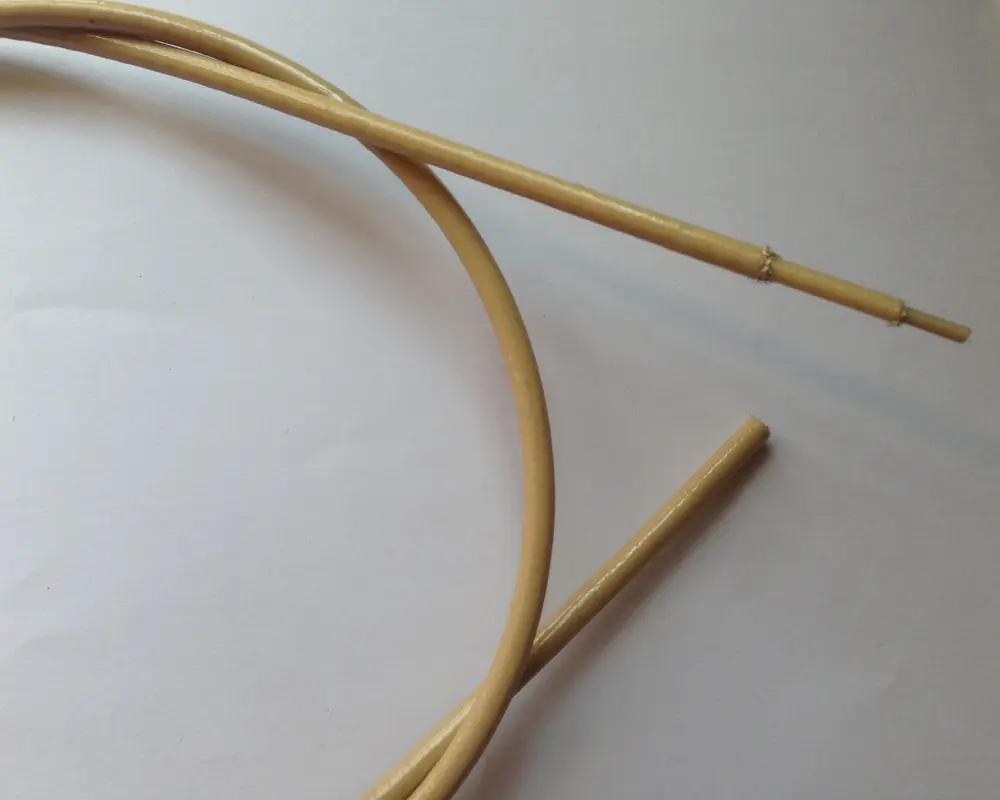
Sie verlassen sich auf das Richtige Kabel für Hybrid-Elektrofahrzeuge Um die Leistungsabgabe, Sicherheit und Effizienz Ihres Fahrzeugs zu optimieren, spielen die Kabelspezifikationen eine direkte Rolle für die tägliche Leistung Ihres Hybridfahrzeugs. Art, Größe, Material und Isolierung jedes Kabels beeinflussen Energieverluste, Wärmeableitung und Langlebigkeit.
Sie können sehen, wie Hitzebeständigkeit, Gewicht und elektromagnetische Störungen die Effizienz und Sicherheit jedes Kabels in Hybrid-Elektrofahrzeugen beeinflussen.
Das Isoliermaterial in einem Kabel eines Hybrid-Elektrofahrzeugs bestimmt dessen Temperaturbeständigkeit, wodurch Ihr Fahrzeug vor Überhitzung geschützt und die Zuverlässigkeit gewährleistet wird.
Bei der Wahl des Kabels für ein Hybrid-Elektrofahrzeug beeinflusst man auch das Gesamtgewicht, was sich wiederum auf Reichweite und Effizienz auswirkt.
Das richtige Kabel für Hybrid-Elektrofahrzeuge hält der Betriebshitze stand und behält seine Leistungsfähigkeit über die Zeit bei.
In Hybridfahrzeugen kommen verschiedene Kabeltypen zum Einsatz, die jeweils für eine bestimmte Funktion ausgelegt sind. Diese Kabel gewährleisten einen sicheren und effizienten Betrieb Ihres Fahrzeugs, auch unter anspruchsvollen Bedingungen.
EV-BatteriekabelSie dienen der Energieübertragung zwischen dem Akku und den elektrischen Systemen. Sie sind für hohe Ströme und Spannungen ausgelegt, die oft Hunderte oder sogar über 1000 Volt erreichen.
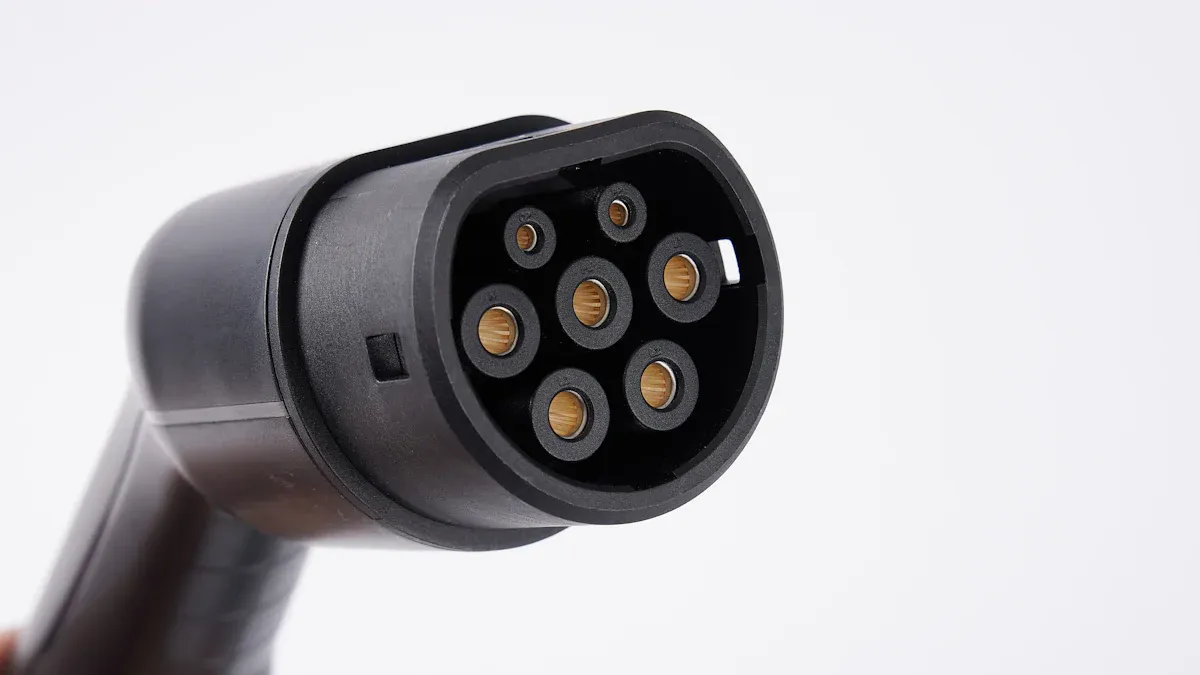
Ladekabel für ElektrofahrzeugeDiese Anschlüsse verbinden Ihr Fahrzeug mit externen Stromquellen. Sie werden sowohl zum Laden zu Hause als auch an öffentlichen Ladestationen verwendet, wobei es Varianten wie Typ 1 und Typ 2 für unterschiedliche Ladestationen gibt.
SignalkabelDiese Systeme steuern die Kommunikation zwischen elektronischen Steuergeräten, Sensoren und Aktoren. Sie sind für eine präzise Datenübertragung und Systemkoordination unerlässlich.
HybridkabelDiese Kabel integrieren mehrere Funktionen, wie z. B. Strom- und Signalübertragung, in einer einzigen Kabelbaugruppe. Sie profitieren von geringerem Gewicht und vereinfachter Installation.
Stromkabel bilden das Rückgrat des elektrischen Systems Ihres Hybridfahrzeugs. Sie lassen sich in zwei Hauptkategorien einteilen:
Hochspannungskabel transportieren Energie von der Batterie zum Elektromotor und anderen Hochleistungskomponenten. Häufig werden drei dicke Adern für die Motorstromversorgung verwendet, um eine effiziente Energieübertragung zu gewährleisten und Verluste zu minimieren. Diese Kabel müssen im Betrieb hohen Temperaturen und mechanischen Belastungen standhalten.
Niederspannungskabel versorgen Hilfssysteme wie Beleuchtung, Infotainment und Steuermodule mit Energie. Diese Kabel sind notwendig, um einen stabilen Betrieb zu gewährleisten und empfindliche Elektronik vor Spannungsschwankungen zu schützen.
Signalkabel spielen eine entscheidende Rolle im Kommunikationsnetzwerk Ihres Fahrzeugs. Sie übertragen Steuersignale, Sensordaten und Rückkopplungen zwischen verschiedenen Modulen. Ihre Abschirmung verhindert elektromagnetische Störungen und gewährleistet so den präzisen und zuverlässigen Betrieb von Sicherheits- und Leistungssystemen.
In Hybridfahrzeugen sind Sie rauen Umgebungsbedingungen ausgesetzt, darunter ständige Vibrationen und erhöhte Temperaturen. Vibrationsfestes, hitzebeständiges Kabel Diese Kabel begegnen diesen Herausforderungen durch die Kombination von Flexibilität, Langlebigkeit und hervorragender Hitzebeständigkeit. Sie eignen sich für Bereiche, die Motorwärme ausgesetzt sind oder häufigen Bewegungen ausgesetzt sind, und tragen zu einem stabilen Ladevorgang und einer zuverlässigen Stromversorgung bei. Ihre robuste Konstruktion reduziert das Risiko von Isolationsfehlern und verlängert die Lebensdauer der Fahrzeugverkabelung.
Tipp: Bei der Auswahl der Kabeltypen für Ihr Hybridfahrzeug sollten Sie stets die spezifischen Anforderungen der jeweiligen Anwendung berücksichtigen. Die richtige Kabelauswahl verbessert die Ladeeffizienz, die Sicherheit und die langfristige Zuverlässigkeit.
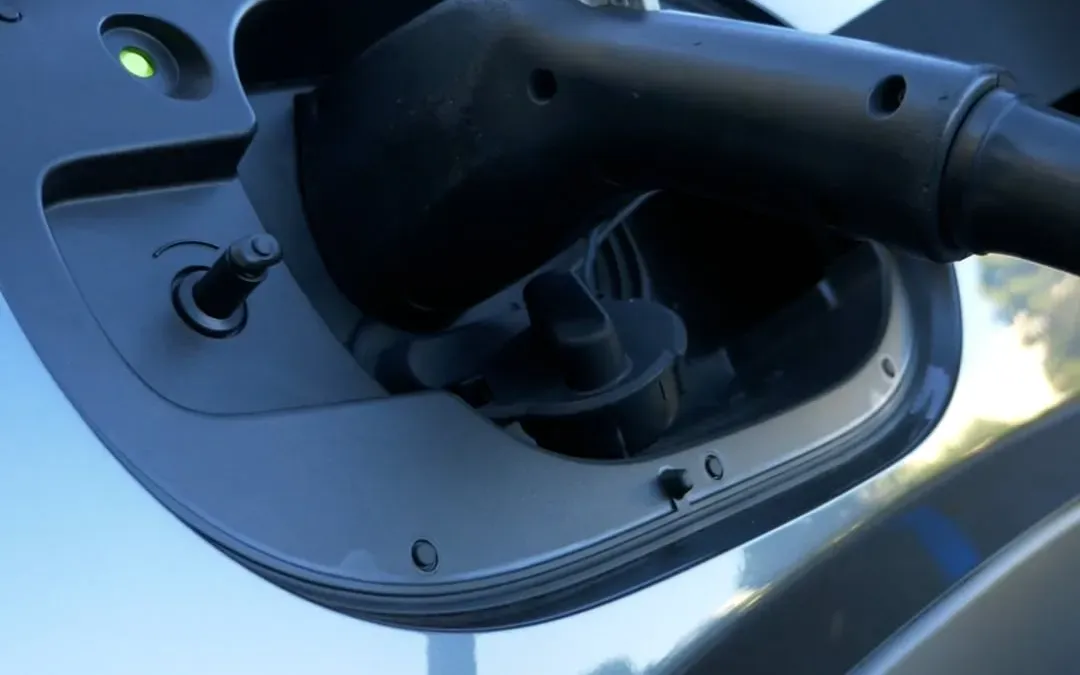
Sie kommen jedes Mal mit verschiedenen Ladekabeln in Kontakt, wenn Sie Ihr Hybrid- oder Elektrofahrzeug an eine Ladestation anschließen. Wenn Sie die Unterschiede zwischen diesen Kabeln kennen, können Sie fundierte Entscheidungen über die Ladeinfrastruktur treffen und sicherstellen, dass Ihr Fahrzeug sicher und effizient geladen wird.
An öffentlichen Ladestationen und Heimladestationen findet man häufig Typ-1- und Typ-2-Ladekabel. Typ-1-Kabel nutzen einen einphasigen Anschluss und eignen sich für viele Hybridfahrzeuge in Nordamerika und Japan. Typ-2-Kabel hingegen unterstützen sowohl einphasiges als auch dreiphasiges Laden. Sie sind europaweit Standard und daher mit nahezu allen Elektrofahrzeugen und Hybridmodellen kompatibel. Typ-2-Kabel bieten flexible Ladeleistungen von 3,7 kW bis 22 kW, sodass Sie die passende Ladestation für Ihre Bedürfnisse auswählen können. Das kombinierte Ladesystem und der CHAdeMO-Anschluss spielen zwar auch beim Schnellladen eine Rolle, Typ 2 ist jedoch nach wie vor der am weitesten verbreitete Typ für den täglichen Gebrauch.
Hier ist ein Vergleich, der Ihnen hilft, die Unterschiede zu verstehen:
Besonderheit | Ladegeräte vom Typ 2 | Ladegeräte vom Typ 3 |
|---|---|---|
Kompatibilität | Dank der standardmäßigen Typ-2-Steckdose ist es mit nahezu allen Elektrofahrzeugen weitgehend kompatibel. | Eingeschränkte Kompatibilität; nur wenige Elektrofahrzeugmodelle sind mit Typ-3-Steckdosen ausgestattet. |
Ladegeschwindigkeit | Bietet Leistungsoptionen von 3,7 kW bis 22 kW, geeignet für verschiedene Ladeanforderungen. | Kann eine Leistung von bis zu 22 kW liefern, vergleichbar mit Ladegeräten des Typs 2. |
Annahme | Standard in Europa und weit verbreitet an kommerziellen Ladestationen. | Begrenzte Verbreitung, hauptsächlich in französischsprachigen Ländern. |
Kommunikationsprotokoll | Verwendet das IEC 61851-1 Modus 2 oder Modus 3 Protokoll, wodurch erweiterte Funktionen wie Überwachung und Fernsteuerung ermöglicht werden. | Verwendet das IEC 61851-1 Mode 3 Protokoll, das von Elektrofahrzeugherstellern weniger unterstützt wird. |
Sie sehen, dass Typ-2-Kabel aufgrund ihrer Kompatibilität und Ladegeschwindigkeit den Markt dominieren. Außerdem fällt auf, dass der SAE-J1772-Stecker in Nordamerika weit verbreitet ist, während das kombinierte Ladesystem und der CHAdeMO-Stecker an vielen Ladestationen Schnellladen mit Gleichstrom ermöglichen.
Sie verwenden Mode-3-Ladekabel an dafür vorgesehenen Ladestationen und Ladepunkten. Diese Kabel verbinden Ihr Fahrzeug direkt mit der Ladeinfrastruktur und bieten fortschrittliche Sicherheitsfunktionen und Kommunikationsprotokolle. Mode 3 unterstützt sowohl fest verbundene als auch flexible Ladekabel und ermöglicht Ihnen so die Nutzung an öffentlichen und privaten Ladepunkten. Fest verbundene Kabel bleiben an der Ladestation angeschlossen, während Sie mit flexiblen Kabeln Ihr eigenes Kabel mitnehmen und verschiedene Ladestationen nutzen können. Sie profitieren von der Fähigkeit von Mode 3, Gleichstrom-Schnellladung zu ermöglichen, was die Ladezeit verkürzt und den Komfort erhöht.
Sie verlassen sich auf robuste Ladekabel für Elektrofahrzeuge mit optimaler Isolierung, um Sicherheit und Leistung zu gewährleisten. Die Isolierung sorgt für elektrische Trennung und verhindert so Stromschläge beim Laden. Sie bietet außerdem mechanischen Schutz und schirmt das Kabel vor Beschädigungen und Umwelteinflüssen wie UV-Licht und Feuchtigkeit ab. Hochtemperaturbeständige Materialien, wie z. B. eine bei 125 °C vernetzte Isolierung, erhalten die Kabelintegrität auch bei der Hitzeentwicklung durch Schnellladen mit Gleichstrom. Diese Materialien sind zudem alterungsbeständig und verschleißfest und verlängern so die Lebensdauer Ihrer Ladekabel.
Die hohe Temperaturbeständigkeit schützt Ihre Kabel beim Schnellladen mit Gleichstrom.
Die Alterungsbeständigkeit schützt vor UV-Strahlung und Feuchtigkeit an Ladestationen im Freien.
Die mechanische Langlebigkeit gewährleistet zuverlässige Leistung an jeder Ladestation.
Sie können Ihr Ladeerlebnis verbessern, indem Sie Ladekabel für Elektrofahrzeuge mit fortschrittlicher Isolierung und mehrlagigem Aufbau wählen. Für Anwendungen, die eine noch höhere Temperaturbeständigkeit erfordern, sollten Sie Folgendes in Betracht ziehen: 150 °C und 200 °C Fluorelastomerdraht, was eine außergewöhnliche Langlebigkeit und Sicherheit für anspruchsvolle Ladeumgebungen gewährleistet.
Bei der Auswahl des Leitermaterials für die Kabel Ihres Hybridfahrzeugs treffen Sie eine wichtige Entscheidung. Der Leiter bestimmt die Effizienz des Stromflusses, die Wärmeentwicklung des Kabels und die maximale Tragfähigkeit Ihres Fahrzeugs. Zwei Hauptoptionen dominieren den Markt: Kupfer und Aluminium.
Sie möchten, dass Ihre Kabel Strom mit minimalen Verlusten übertragen. Kupfer zeichnet sich durch seine hervorragende elektrische Leitfähigkeit aus. Aluminium ist zwar leichter, erreicht aber nicht die gleiche Stromleitfähigkeit wie Kupfer. Die folgende Tabelle vergleicht die beiden Materialien:
Eigentum | Kupfer (Cu) | Aluminium (Al) |
|---|---|---|
Leitfähigkeit (IACS) | 100% | ~61% |
Spezifischer Widerstand (Ω·mm²/m) | 0,0172 | 0,0282 |
Kupfer bietet die höchste Leitfähigkeit, was geringere Energieverluste und niedrigere Wärmeentwicklung bedeutet. Der höhere spezifische Widerstand von Aluminium erfordert einen größeren Querschnitt, um die gleiche Leistung wie bei Kupfer zu erzielen. Dieser Unterschied beeinflusst sowohl die Effizienz als auch die Kabelkonstruktion.
Sie müssen auch das Gewicht der Fahrzeugverkabelung berücksichtigen. Aluminium bietet hier einen deutlichen Vorteil:
Aluminium wiegt etwa ein Drittel so viel wie Kupfer, was dazu beiträgt, das Gesamtgewicht Ihres Fahrzeugs zu reduzieren.
Leichtere Kabel können die Reichweite und Effizienz Ihres Fahrzeugs verbessern, da weniger Energie zum Bewegen des Fahrzeugs benötigt wird.
Viele Ingenieure verwenden Aluminium für Stromschienen und bestimmte Verdrahtungskomponenten und erzielen damit Gewichtseinsparungen von bis zu 50 % im Vergleich zu Kupfer.
Von diesen Gewichtseinsparungen profitieren Sie insbesondere bei Hybrid-Elektrofahrzeugen, wo jedes Kilogramm zählt.
Stellen Sie sich zwei Straßen vor: eine glatte, frisch asphaltierte und eine andere mit kleinen Steinen und Geröll. Ein Auto kann auf beiden fahren, aber die glatte Straße ermöglicht eine schnellere und gleichmäßigere Fahrt. Elektrizität verhält sich in Leitern ähnlich. Hochreine Materialien bieten Elektronen einen freien Weg, während Verunreinigungen wie Hindernisse wirken, den Widerstand erhöhen und Energie verschwenden.
Bei den Kabeln Ihres Hybridfahrzeugs sollten Sie stets auf hochreine Leitermaterialien achten. Die Reinheit beeinflusst den Widerstand direkt. Verunreinigungen stören den Elektronenfluss und verursachen dadurch mehr Wärme und Energieverluste. Mit der Zeit belastet diese zusätzliche Wärme die Isolierung, was zu vorzeitigem Verschleiß oder sogar elektrischen Fehlern führen kann. Verunreinigungen beschleunigen zudem Korrosion und Materialermüdung und verringern so die Langzeitstabilität Ihrer Kabel.
Hersteller messen die Reinheit anhand von Industriestandards wie Leitfähigkeitstests und chemischen Analysen. Kupferleiter sind beispielsweise häufig in Reinheitsgraden von 99,90 %, 99,95 % oder sogar 99,999 % erhältlich. Schon geringe Unterschiede in der Reinheit können spürbare Veränderungen der Leitfähigkeit, der Wärmeentwicklung und der Lebensdauer des Kabels zur Folge haben. Optimale Leistung und Langlebigkeit gewährleisten Sie durch die Wahl von Kabeln mit höchstmöglicher Reinheit.
Bei der Entwicklung und Wartung eines Hybridfahrzeugs müssen Sie wichtige Entscheidungen bezüglich der Kabeldimensionierung treffen. Die richtige Kabeldimensionierung gewährleistet sicheres und effizientes Laden sowie eine zuverlässige Stromversorgung. Dabei sind verschiedene Faktoren zu berücksichtigen, wie z. B. Leiternormen, Spannungsbereich und die Umgebungsbedingungen. Bei der Auswahl eines Ladekabels achten Sie auf Betriebsspannung, Stromstärke und Temperaturanstieg. Vergleichen Sie außerdem Spitzenstrom und -dauer mit der Kennlinie des Kabels. So finden Sie die optimale Kabeldimensionierung für Ihr Ladesystem.
Die Strombelastbarkeit des Ladekabels muss den Ladeanforderungen Ihres Fahrzeugs entsprechen. Ein zu dünnes Kabel birgt die Gefahr von Überhitzung und Energieverlust beim Ladevorgang. Ein zu dickes Kabel verursacht unnötiges Gewicht und Kosten. Orientieren Sie sich an Industriestandards wie LV216-1/2 und ISO19642, um die richtige Wahl zu treffen. Diese Standards helfen Ihnen, die Betriebsspannung (üblicherweise unter 1000 V DC) zu überprüfen und den passenden Durchmesser für Ihre Ladekabel zu bestimmen.
Sie möchten den Energieverlust beim Laden minimieren. Mit einem Kabel des richtigen Querschnitts reduzieren Sie den Widerstand und halten den Energieverlust gering. Ist das Kabel zu dünn, steigt der Widerstand, und es geht mehr Energie in Form von Wärme verloren. Dieser Verlust beeinträchtigt die Effizienz des Ladevorgangs und kann die Lebensdauer der Fahrzeugelektrik verkürzen. Prüfen Sie daher stets den effektiven Betriebsstrom und stellen Sie sicher, dass das Kabel den Spitzenstrom während des Ladevorgangs aushält.
Sie müssen die Wärmeentwicklung Ihrer Ladekabel kontrollieren. Übermäßige Hitze kann die Isolierung beschädigen und die Lebensdauer des Kabels verkürzen. Die Kabelquerschnitte wählen Sie anhand der Temperaturerhöhung und der Strombelastbarkeit. Sie stellen außerdem sicher, dass die Sicherung auslöst, bevor das Kabel seinen kritischen Punkt erreicht. So schützen Sie Ihr Fahrzeug bei Ladevorgängen mit hohem Strom. Sie verwenden Kabel mit fortschrittlicher Isolierung, wie sie beispielsweise in vibrationsfesten und hitzebeständigen Kabeln zu finden sind, um der beim Schnellladen entstehenden Hitze standzuhalten.
Tipp: Überwachen Sie während des Betriebs stets die Temperatur Ihrer Ladekabel. Dauerhafte Überhitzung deutet auf die Notwendigkeit eines größeren Kabelquerschnitts oder einer verbesserten Isolierung hin.
Um Ladeeffizienz und -leistung zu optimieren, wird die Kabelgröße an das Fahrzeuggewicht angepasst. Bei Hochspannungssystemen wie 48 V können kleinere Ladekabel verwendet werden. Diese Kabel sind leichter und enthalten weniger Kupfer als herkömmliche 12-V-Kabel. Zum Beispiel:
48V-Ladekabel haben etwa 10% des Durchmessers und Gewichts von 12V-Kabeln.
Kleinere Ladekabel reduzieren das Gesamtgewicht Ihres Fahrzeugs.
Ein geringeres Gewicht verbessert die thermische Effizienz und steigert die Fahrzeugleistung während des Ladevorgangs.
Sie sehen also, dass jedes eingesparte Kilogramm Kabelgewicht die Reichweite Ihres Fahrzeugs erhöht und die Ladegeschwindigkeit verbessert. Außerdem senken Sie die Materialkosten und steigern die Effizienz Ihres Fahrzeugs. Mit der richtigen Kabelgröße erzielen Sie ein optimales Verhältnis zwischen Sicherheit, Leistung und Gewicht.
Sie können Ihr Ladesystem weiter optimieren, indem Sie Kabel mit Hochtemperaturisolierung, wie z. B. 150 °C- und 200 °C-Fluorelastomer-Kabel, wählen. Diese Kabel gewährleisten ihre Leistungsfähigkeit auch bei intensiven Ladevorgängen und unter anspruchsvollen Bedingungen.
Sie verlassen sich auf fortschrittliche Isolierung und Hitzebeständigkeit, um die zuverlässige Funktion der Kabel Ihrer Hybridfahrzeuge auch unter anspruchsvollen Bedingungen zu gewährleisten. Isoliermaterialien schützen vor elektrischen Fehlern, mechanischen Beschädigungen und Umwelteinflüssen. Hochleistungsisolierung erhält die Kabelintegrität zudem bei hohen Temperaturen und Vibrationen.
In den Antriebssträngen von Hybridfahrzeugen treten extreme Temperaturen auf, insbesondere in der Nähe von Motoren und Akkus. Isoliermaterialien mit höherer Temperaturbeständigkeit bieten überlegene Haltbarkeit und Sicherheit. Die folgende Tabelle vergleicht gängige Isoliermaterialien, die in Kabeln von Hybridfahrzeugen verwendet werden:
Eigentum | PVC | TPU | Bestrahlungsvernetzt |
|---|---|---|---|
Maximale Betriebstemperatur | ~70℃ | ~90℃ | 125℃ kontinuierlich |
UV-Beständigkeit | Niedrig | Medium | Hoch |
Flexibilität bei Kälte | Arm | Gut | Exzellent |
Mechanische Festigkeit | Niedrig | Medium | Hoch |
Umweltkonformität | Halogeniert | Variable | Halogenfrei |
Kosten | Niedrig | Medium | Höher (aber lang anhaltend) |
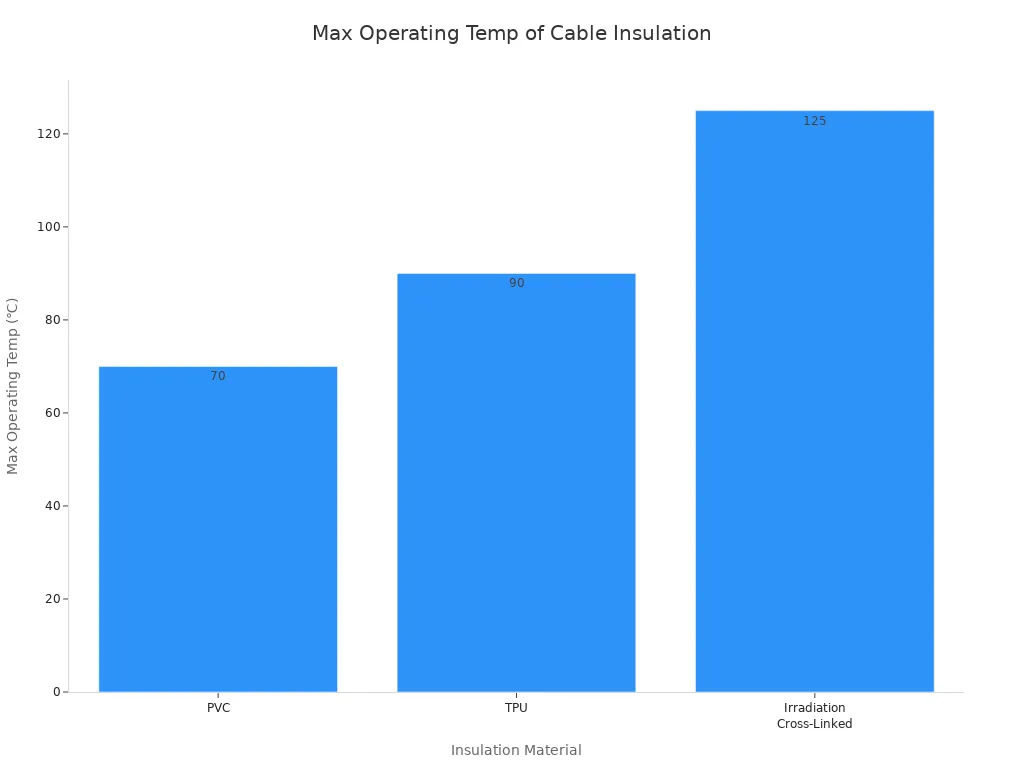
Isoliermaterialien mit einer Temperaturbeständigkeit von 125 °C oder höher, wie z. B. strahlungsvernetzte Verbindungen, sind beständig gegen Zersetzung und behalten ihre strukturelle Integrität auch unter hohen Strombelastungen. Materialien mit niedrigerer Temperaturbeständigkeit, wie z. B. PVC, können bei erhöhten Temperaturen weich werden und an Festigkeit verlieren, was die Brandgefahr erhöht und die Lebensdauer von Kabeln verkürzt.
Mit Fluorelastomer-Draht erzielen Sie eine noch höhere Hitzebeständigkeit. AFLAS-Fluorelastomere halten Temperaturen bis zu 200 °C stand und eignen sich daher ideal für Hybridfahrzeuge. FEPM-Fluorelastomere bieten zudem eine hohe Langzeitstabilität in Hochtemperaturumgebungen. Diese Werkstoffe gewährleisten Zuverlässigkeit auch bei konstanter thermischer Belastung.
AFLAS-Fluorelastomere arbeiten zuverlässig bei Temperaturen bis zu 200°C.
FEPM-Fluorelastomere bieten dauerhafte Leistung in Hochtemperaturzonen.
Fluorelastomer-Isolierung bleibt nicht brennbar und trägt so zur Sicherheit in Elektro- und Hybridfahrzeugen bei.
Sie benötigen Kabel, die jahrelang halten. Fluorelastomer-Kabel sind beständig gegen Chemikalien, mechanischen Abrieb und Temperaturschwankungen. Ihre Nichtbrennbarkeit schützt Ihr Fahrzeug vor Brandgefahren. Sie profitieren von ihrer Flexibilität und Isolationsfähigkeit, selbst nach wiederholten Heiz- und Kühlzyklen.
Für kritische Bereiche, in denen Hitzebeständigkeit und Langlebigkeit entscheidend sind, empfiehlt sich Fluorelastomer-Draht. So sichern Sie sich langfristige Zuverlässigkeit und reduzieren den Wartungsaufwand.
In Hybridfahrzeugen treten ständige Vibrationen auf, insbesondere in der Nähe von Motoren und Fahrwerkskomponenten. Vibrationsdämpfende Merkmale schützen die Kabelintegrität und verhindern Isolationsfehler.
Hoonsun-Dichtungen bieten effektive Vibrationsdämpfung und außergewöhnliche Beständigkeit gegenüber hohen Temperaturen. Sie ermöglichen ein hervorragendes Kabelmanagement und einen optimalen Strukturschutz, was für die Aufrechterhaltung der Leistungsfähigkeit unter Vibrationen unerlässlich ist.
Zusätzliche Verriegelungsmechanismen verbessern die Vibrationsfestigkeit.
Die Dichtungen bieten Schutz vor Umwelteinflüssen (IP67+) und gewährleisten Langlebigkeit.
Geschirmte, kompakte Steckverbinder gewährleisten die Signalintegrität auch bei Betrieb mit starken Vibrationen.
Flexible Kabelmaterialien wie Silikon und moderne TPE-Mischungen widerstehen häufigen Bewegungen und Vibrationen.
Spiral- und aufrollbare Kabelkonstruktionen bieten Formgedächtnis und elastische Rückstellung, was die Vibrationsfestigkeit weiter verbessert.
Die Integrität der Kabel wird durch die Auswahl von Kabeln mit robusten Vibrationsdämpfungseigenschaften gewährleistet. Diese Konstruktionen garantieren einen stabilen Betrieb und reduzieren das Risiko elektrischer Fehler.
Für die anspruchsvollsten Umgebungen können Sie sich verlassen auf 150 °C und 200 °C Fluorelastomerdraht Um eine unübertroffene Hitzebeständigkeit und Langlebigkeit zu gewährleisten, trägt diese Wahl zu optimaler Leistung und Sicherheit in Hybridfahrzeugen bei.
Sie kommen bei jedem Ladevorgang Ihres Hybridfahrzeugs mit den Ladeanschlüssen in Kontakt. Diese Anschlüsse bilden die entscheidende Verbindung zwischen Ihrem Fahrzeug und der Ladestation. Die richtigen Anschlüsse gewährleisten einen sicheren und effizienten Energiefluss und unterstützen so die Gesamtleistung Ihres Fahrzeugs. Kabel für Hybrid-ElektrofahrzeugeSie müssen außerdem die Kompatibilität und Qualität der daran angebrachten Steckverbinder berücksichtigen.
Die Qualität der Ladeanschlüsse für Elektrofahrzeuge beeinflusst direkt die Zuverlässigkeit und Sicherheit Ihres Ladesystems. Hochwertige Anschlüsse gewährleisten eine sichere und stabile Verbindung, die für eine effiziente Energieübertragung unerlässlich ist.
Für eine sichere Verbindung zwischen Ladekabel und Fahrzeug sind die Steckverbinder unerlässlich. Das Steuergerät prüft die Steckverbinder vor Ladebeginn. Sollten die Steckverbinder nicht korrekt einrasten, unterbricht das System die Verbindung, um Risiken wie Lichtbögen oder Überhitzung zu vermeiden. Dieser Vorgang schützt Sie und Ihr Fahrzeug vor gefährlichen Situationen. Zuverlässige Steckverbinder tragen außerdem zu einem gleichmäßigen Stromfluss bei und verringern so die Wahrscheinlichkeit von Ladeunterbrechungen.
Steckverbinder spielen beim Ladevorgang eine entscheidende Rolle, indem sie eine korrekte Verbindung gewährleisten.
Das System prüft die Anschlüsse auf Betriebsbereitschaft, bevor die Energieübertragung zugelassen wird.
Wenn eine Verriegelung verrutscht oder ein Stecker ausfällt, stoppt das System den Ladevorgang, um Gefahren zu vermeiden.
Um die langfristige Leistungsfähigkeit Ihrer Ladeanschlüsse zu gewährleisten, ist die regelmäßige Wartung unerlässlich. Überprüfen Sie Ihre Anschlüsse sorgfältig, um Anzeichen von Verschleiß, Korrosion oder Beschädigungen frühzeitig zu erkennen. Saubere Anschlüsse sorgen für besseren Kontakt und reduzieren den Widerstand, was die Ladeeffizienz steigert. Sollten Sie Probleme feststellen, tauschen Sie die Anschlüsse umgehend aus, um Sicherheitsrisiken zu vermeiden. Die Verwendung eines vibrationsfesten und hitzebeständigen Kabels ist ebenfalls empfehlenswert, da diese Kabel und ihre Anschlüsse auch unter rauen Umgebungsbedingungen und bei häufigem Gebrauch zuverlässig funktionieren.
Prüfen Sie die Steckverbinder auf Beschädigungen oder Korrosion.
Reinigen Sie die Steckverbinder regelmäßig, um einen optimalen Kontakt zu gewährleisten.
Ersetzen Sie abgenutzte oder beschädigte Steckverbinder, um die Sicherheit zu gewährleisten.
Die Leistung Ihres Hybridfahrzeugs hängt von der Qualität und dem Zustand der Ladeanschlüsse ab. Diese Anschlüsse sind Bestandteil der Ladeinfrastruktur (EVSE), zu der auch Kabel und Schutzvorrichtungen gehören. Die EVSE gewährleistet eine standardisierte und sichere Energieübertragung zwischen Stromquelle und Fahrzeug. Strenge Tests und die Einhaltung von Industriestandards garantieren die zuverlässige Funktion der Anschlüsse.
Hochwertige Stecker sorgen für kürzere Ladezeiten und weniger Unterbrechungen. Minderwertige Stecker können Energieverluste, Überhitzung oder sogar Systemausfälle verursachen. Wählen Sie daher stets Stecker, die strenge Sicherheits- und Haltbarkeitsstandards erfüllen. Für anspruchsvolle Umgebungen empfiehlt sich die Verwendung von … 150 °C und 200 °C Fluorelastomerdraht mit kompatiblen Anschlüssen, um die besten Ergebnisse zu erzielen.
Tipp: Achten Sie stets darauf, dass die Stecker zu den Anforderungen Ihres Fahrzeugs und der Ladeumgebung passen. Dies gewährleistet optimale Leistung und verlängert die Lebensdauer Ihres Ladesystems.
Sie streben bei jedem Hybridfahrzeug nach maximaler Energieeffizienz. Die Kabelspezifikationen spielen eine entscheidende Rolle für die Effizienz der Energieübertragung während des Ladevorgangs und im Betrieb. Durch die Auswahl von Kabeln mit hoher Leitfähigkeit und optimalem Querschnitt minimieren Sie Energieverluste. Kupferleiter bieten überlegene Leistung, jedoch muss ein ausgewogenes Verhältnis zwischen Gewicht und Flexibilität gefunden werden. Aluminium ist eine leichtere Alternative, benötigt aber größere Durchmesser, um die Effizienz von Kupfer zu erreichen.
Auch die Isoliermaterialien spielen eine wichtige Rolle. Hochwertige Isolierungen reduzieren den Widerstand und verhindern unnötige Wärmeentwicklung. Durch die Verwendung von Kabeln mit hochreinen Leitern und robuster Isolierung wird sichergestellt, dass mehr Energie Motor und Batterie erreicht, anstatt als Wärme verloren zu gehen. Dies erhöht die Reichweite Ihres Fahrzeugs und verkürzt die Ladezeit.
Tipp: Achten Sie stets darauf, dass die Kabelspezifikationen den Ladeanforderungen Ihres Fahrzeugs entsprechen. Die richtige Auswahl verbessert die Energieeffizienz und ermöglicht schnellere Ladezyklen.
Beim Betrieb von Hybridfahrzeugen ergeben sich erhebliche Herausforderungen im Bereich des Wärmemanagements. Die Wahl des Kabels hat direkten Einfluss darauf, wie gut Ihr Fahrzeug die thermische Belastung während des Ladevorgangs und im Betrieb unter hoher Leistung bewältigt. Häufige Herausforderungen sind:
Umgang mit Wärmeeinwirkung auf Kabel in der Nähe von Akkus und Motoren
Auswahl geeigneter Dämmstoffe für Hochtemperaturzonen
Gewährleistung von Flexibilität und Haltbarkeit unter kontinuierlicher thermischer Belastung
Sie müssen Dämmstoffe auswählen, die für den zu erwartenden Temperaturbereich geeignet sind. Hier ist ein Vergleich gängiger Dämmstoffarten und ihrer Temperaturkennwerte:
Isoliermaterial | Maximale Betriebstemperatur |
|---|---|
PVC | 90° bis 105°C |
Thermoplastisches Polyurethan (TPU) | Bis zu 125 °C |
Vernetztes Polyethylen (XLPE) | Bis zu 125 °C |
Bestrahlung XLPE | Bis zu 150 °C |
Silikone und vernetzte Fluorelastomere (XLFEs) | Bis zu 200 °C |
Sie setzen auf fortschrittliche Isoliermaterialien zur Optimierung des Wärmemanagements. Keramikfasern spielen aufgrund ihrer außergewöhnlichen Hitzebeständigkeit und ihres Brandschutzes eine bedeutende Rolle im Markt für Isolierungen in Elektrofahrzeugen. Silikonkautschuk bietet Flexibilität und hohe Wärmebeständigkeit, was eine lange Lebensdauer und erhöhte Sicherheit in Hochspannungsumgebungen ermöglicht. Wärmeleitmaterialien verbessern die Wärmeleitfähigkeit und verhindern so eine Überhitzung von Akkus und Leistungselektronik.
Bei der Auswahl von Kabeln mit Hochtemperaturisolierung, wie z. B. 150 °C und 200 °C FluorelastomerdrahtSie schützen Ihr Fahrzeug vor Überhitzung und gewährleisten eine zuverlässige Ladeleistung. Diese Materialien widerstehen extremer Hitze und behalten ihre strukturelle Integrität, wodurch wichtige Sicherheitsmerkmale unterstützt werden.
Notiz: Effektives Wärmemanagement verlängert die Lebensdauer der Kabel und reduziert den Wartungsaufwand. Überprüfen Sie vor der Verlegung von Kabeln in Hochtemperaturbereichen stets die Isolationswerte.
Sie erwarten von jedem Kabel in Ihrem Hybridfahrzeug Langlebigkeit. Umwelteinflüsse wie Temperatur, Vibrationen, Luftfeuchtigkeit und mechanische Belastungen beeinträchtigen die Lebensdauer der Kabel. Industriestandards wie ISO 16750-3 und ISO 16750-4 regeln die mechanischen und klimatischen Belastungen. Diese Standards fordern, dass Kabel Vibrationen, Stößen, Feuchtigkeit, Staub, Korrosion und Eis standhalten.
Sie durchlaufen kombinierte Feuchtigkeits- und Vibrationstests, die reale Bedingungen simulieren. Die Temperaturprüfungen reichen von -45 °C bis 50 °C, wobei für Kabel in der Nähe von Motoren oder bei Sonneneinstrahlung höhere Grenzwerte gelten. Umwelttests gewährleisten die Wirksamkeit und Sicherheit der Kabel sowohl auf Fahrzeug- als auch auf Subsystemebene.
Eine höhere Lebensdauer erzielen Sie durch die Auswahl von Kabeln mit robuster Isolierung und Vibrationsdämpfung. Flexible Materialien wie Silikon und Fluorelastomere behalten ihre Leistungsfähigkeit auch bei wiederholter Bewegung und Temperaturwechseln. Wenn Sie Kabel wie diese verwenden Vibrationsfestes, hitzebeständiges KabelSie gewährleisten ein stabiles Laden und schützen vor Isolationsfehlern.
Tipp: Wählen Sie Kabel, die auf Vibrationen und klimatische Belastungen geprüft wurden. Dies gewährleistet eine lange Lebensdauer und unterstützt wichtige Sicherheitsmerkmale in Hybridfahrzeugen.
Bei der Auswahl von Kabeln für Hybridfahrzeuge hat Sicherheit oberste Priorität. Das richtige Hybridfahrzeugkabel schützt Sie vor elektrischen Gefahren und gewährleistet den zuverlässigen Betrieb Ihres Fahrzeugs unter allen Bedingungen. Industriestandards schreiben vor, dass Kabel strenge Tests bestehen müssen, bevor sie in Ihrem Fahrzeug verbaut werden. Diese Tests bestätigen, dass jedes Kabel den rauen Umgebungsbedingungen und den hohen Spannungen moderner Hybridsysteme standhält.
Testkategorie | Zweck |
|---|---|
Thermische Alterungstests | Bewertung der Materialeigenschaften nach längerer Wärmeeinwirkung (z. B. 125 °C über 3000 Stunden). |
Durchschlagsfestigkeits- und Isolationswiderstandsprüfungen | Messung des Widerstands gegen elektrischen Durchschlag bei hohen Spannungen (1.000 V bis 5.000 V). |
Flammenausbreitungstests | Es ist sicherzustellen, dass die verwendeten Materialien nicht zur Brandausbreitung beitragen oder giftigen Rauch freisetzen (IEC 60332-1, UL 94). |
Kälteflexibilitäts- und Abriebprüfungen | Beurteilen Sie die Haltbarkeit unter winterlichen Bedingungen und bei Vibrationen. |
Prüfung der chemischen Beständigkeit | Simulation der Einwirkung verschiedener Kfz-Flüssigkeiten. |
Wassersprüh- und Kondensationstests | Unerlässlich für Kabel, die unter dem Fußboden oder in der Nähe von Heizungs-, Lüftungs- und Klimaanlagen verlegt werden. |
Sie verlassen sich auf diese Tests, um sicherzustellen, dass die Fahrzeugverkabelung auch unter Belastung nicht versagt. Beispielsweise gewährleisten Flammenausbreitungstests, dass Kabel kein Feuer ausbreiten oder schädlichen Rauch freisetzen. Tests zur Durchschlagsfestigkeit und zum Isolationswiderstand bestätigen, dass Kabel hohen Spannungen standhalten, ohne Kurzschlüsse oder Leckströme zu verursachen. Kälteflexibilitäts- und Abriebtests prüfen, ob die Kabel auch bei winterlichen Fahrbedingungen und ständigen Vibrationen ihre Haltbarkeit behalten.
Automobilingenieure nutzen fortschrittliche Systeme zur Überwachung der Kabelintegrität. Die Hochspannungs-Verriegelungsschleife (HVIL) prüft den Zustand von Hochspannungsmodulen, Kabeln und Steckverbindern. Bei einem erkannten Fehler schaltet das System den Hochspannungskreis ab. Die HVIL verhindert Stromschläge, indem sie sicherstellt, dass die Spannungspegel im sicheren Bereich liegen, bevor Sie oder ein Techniker Bauteile berühren. Dieser automatische Schutz steht Ihnen bei jeder Fahrt und jeder Wartung Ihres Fahrzeugs zur Verfügung.
HVIL überwacht das gesamte Hochspannungssystem auf Fehler.
Bei Auftreten eines Problems wird die Stromzufuhr sofort unterbrochen.
Sie vermeiden einen Stromschlag, da HVIL vor dem Kontakt für sichere Spannungspegel sorgt.
Sie sollten auch die Feuer-, Chemikalien- und Wasserbeständigkeit des Kabels berücksichtigen. Hybridfahrzeuge sind häufig anspruchsvollen Umgebungen ausgesetzt, beispielsweise auf nassen Straßen oder in der Nähe von Motorräumen. Ein vibrationsfestes und hitzebeständiges Kabel bietet zusätzlichen Schutz vor Hitze, Vibrationen und Feuchtigkeit. Dieses Kabel behält seine Struktur und Isolierung auch unter extremen Bedingungen bei und reduziert so das Risiko von Kurzschlüssen oder Bränden.
Durch die Wahl von Kabeln mit hochwertiger Isolierung erhöhen Sie die Sicherheit zusätzlich. Materialien wie Fluorelastomer-Kabel mit einer Temperaturbeständigkeit von 150 °C und 200 °C bieten eine hervorragende Beständigkeit gegenüber Hitze und Chemikalien. Diese Kabel sind schwer entflammbar und entwickeln keinen giftigen Rauch, was Sie und Ihre Mitfahrer im Brandfall schützt. Sie können sich darauf verlassen, dass diese fortschrittlichen Materialien die Sicherheit und Zuverlässigkeit der Fahrzeugelektrik gewährleisten.
Tipp: Wählen Sie stets Kabel, die die branchenüblichen Sicherheitsstandards erfüllen oder übertreffen. Diese Entscheidung schützt Sie, Ihr Fahrzeug und alle anderen Verkehrsteilnehmer.
Sie optimieren Leistung, Sicherheit und Zuverlässigkeit durch die Auswahl der richtigen Kabelspezifikationen für Hybridfahrzeuge. Mit fortschrittlichen Leitermaterialien und präziser Kabeldimensionierung maximieren Sie die Ladeeffizienz. Hitzebeständige und vibrationsfeste Isolierungen verbessern die Ladesicherheit. Profitieren Sie von Innovationen wie wärmeleitender Isolierung, nanomaterialverstärkten Leitern und intelligenten Kabeln, die den Ladezustand überwachen. Kompakte Kabeldesigns und eine erhöhte Ladelebensdauer werden durch Co-Extrusionsverfahren gewährleistet. Optimale Ladeleistung erreichen Sie durch höchste Kabelqualität in jedem Ladesystem. Langfristige Ladezuverlässigkeit sichern Sie sich mit Fluorelastomer-Drähten, die Temperaturen von 150 °C und 200 °C standhalten.
Sie verwenden ein Ladekabel für Hybridfahrzeuge, da es höhere Spannungen und Ströme aushält. Dieses Kabel ermöglicht effizientes Laden, ist hitzebeständig und gewährleistet Sicherheit. Standard-Autoladekabel genügen den Anforderungen von Hybridsystemen oder fortschrittlichen Ladeanforderungen nicht.
Wählen Sie Ladekabel, die für den maximalen Ladestrom und die maximale Ladespannung Ihres Fahrzeugs ausgelegt sind. Achten Sie auf eine robuste Isolierung und Hitzebeständigkeit. Schnellladen erzeugt mehr Wärme, daher benötigen Sie Kabel, die auch bei schnellen Ladezyklen Leistung und Sicherheit gewährleisten.
Die Isolierung schützt Sie vor Stromschlägen und verhindert Kurzschlüsse beim Laden. Sie schützt das Kabel außerdem vor Hitze und Umwelteinflüssen. Eine hochwertige Isolierung gewährleistet, dass Ihr Ladesystem auch bei intensiver Nutzung sicher und zuverlässig bleibt.
Ja, Vibrationen können mit der Zeit zu Verschleiß und Isolationsfehlern führen. Dieses Risiko lässt sich durch die Verwendung eines vibrationsfesten und hitzebeständigen Kabels reduzieren. Dieses Kabel gewährleistet eine stabile Ladeleistung, selbst in Bereichen mit ständiger Bewegung oder Motorvibrationen.
Wählen Sie Ladekabel mit einer Temperaturbeständigkeit, die der Ladeumgebung Ihres Fahrzeugs entspricht. Für anspruchsvolle Anwendungen bieten Kabel mit einer Temperaturbeständigkeit von 150 °C oder 200 °C optimalen Schutz. Fluorelastomer-Drähte mit einer Temperaturbeständigkeit von 150 °C und 200 °C gewährleisten, dass Ihre Ladekabel extremer Hitze standhalten.
Überprüfen Sie Ihre Ladekabel regelmäßig auf Abnutzungserscheinungen, Beschädigungen oder Korrosion. Häufige Kontrollen helfen Ihnen, Probleme frühzeitig zu erkennen und ein sicheres Laden zu gewährleisten. Tauschen Sie Kabel umgehend aus, wenn Sie Mängel feststellen.
Ja, Stecker spielen beim Ladevorgang eine entscheidende Rolle. Sichere, hochwertige Stecker gewährleisten einen stabilen Stromfluss und reduzieren Energieverluste. Minderwertige Stecker können zu Überhitzung oder Ladeunterbrechungen führen. Verwenden Sie daher immer Stecker, die zu Ihrem Kabel und Fahrzeug passen.
Sie profitieren von Industriestandards, die Anforderungen an die Sicherheit von Ladekabeln festlegen. Diese Standards umfassen Isolierung, Hitzebeständigkeit und Langlebigkeit. Die Einhaltung dieser Standards gewährleistet, dass Ihre Ladekabel zuverlässig funktionieren und Sie bei jedem Ladevorgang schützen.
3F, C Build, NO.10, MinChang Road, Nance, HuMen DongGuan City,GuangDong.China.


 IPv6-Netzwerk unterstützt